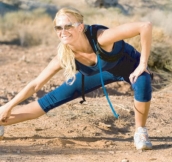
 | Stretching has often been seen as a means to increase flexibility, improve muscle strength and tone as well as improve breathing and reduce stress. However, some of the latest research suggests that having greater flexibility may also increase arterial flexibility which may put you at lower risk for a heart attack and/or a stroke. The study suggests that those with poorer flexibility may have more rigid arterial walls which make the heart work harder to pump blood. |
However, the study also points out that stiff arteries don’t necessarily indicate or inevitably lead to arterial disease. That being said, this just might be reason enough to check out that yoga class at the gym in the mornings before/after work, pick up a yoga DVD for home or start an office stretching regime at your desk.
| |

Wednesday, 25 July 2012
Stretching for Heart Health

Monday, 16 July 2012
How to Get to Your Healthy Weight
Our daughter Lindsay, sent the following link as a suggested post for our blog. Lindsay is a Registered Dietitian and is our "go-to" person when we are looking to get reliable and up-to-date information about food, eating, metabolism .....just about everything related to nutrition. Lindsay is also a fitness instructor and is often asked these types of questions by her clients. Rather than dissect anything from this article, you're getting the whole thing. It addresses the following:
Here's the link:
http://www.hsph.harvard.edu/nutritionsource/healthy-weight/healthy-weight-full-story/
- Obesity and Health Risks
- What's a Healthy Weight? Body Mass Index (BMI) Defined
- Waist Size Matters Too: Abdominal Fat and Health Risks
- Keeping Things Level
- What Causes Weight Gain?
- What Leads to Weight Loss?
- Lessons From Losers
- General Strategies for Achieving or Maintaining a Health Weight
- The Bottom Line: Recommendations for Health Weight
- References
Here's the link:
http://www.hsph.harvard.edu/nutritionsource/healthy-weight/healthy-weight-full-story/
Wednesday, 27 June 2012
Standing Ab Exercises
It can
be a defining moment in an adult's life, that moment when they realize they
don't have to do a zillion crunches in their workout. In fact, it is
entirely possible to work the Abs and back without a single crunch...without
even getting on the floor.
We also know that working the body as a whole is a lot more effective than trying to isolate different muscle groups (like crunches do). What that means for your Abs is that, while crunches and other floor exercises still have a place in our training routines, standing Ab work can add a new depth and dimension to your workouts, giving you more than just strong Abs, but a strong core.
What do you think? Are you over crunches and looking for something new? How do you work your Abs and do you focus on both floor and standing exercises?
Here’s what I think are the 10 most effective Ab exercises:


While side bends won't necessarily whittle your waist (that comes from losing body fat), this overhead side bend is a great way to strengthen the muscles of the waist (the obliques) while also targeting the Abs and lower back.

The windmill is an excellent exercise for the entire body with a strong focus on the obliques and the lower back. With this move, formis everything. You can add intensity by holding weights in both hands.


Not only is it possible but, in some respects, it's preferable.
Floor exercises have their place, of course, but working the Abs from a
standing position, either with exercises that are integrated into your workout,
or with targeted core exercises, focuses on the Abs the way they function in
real life - as a support for all the movements you do each day ….walking,
bending over to pick something up, lifting something overhead or twisting
around to grab something behind you.
The study behind these exercises suggest these moves are the
best for recruiting all those muscle fibers in your Abs but, with the shift
towards functional training, we now understand that we need strong Abs, not
just while lying on the floor, but for all the movements we perform each day.
We also know that working the body as a whole is a lot more effective than trying to isolate different muscle groups (like crunches do). What that means for your Abs is that, while crunches and other floor exercises still have a place in our training routines, standing Ab work can add a new depth and dimension to your workouts, giving you more than just strong Abs, but a strong core.
What do you think? Are you over crunches and looking for something new? How do you work your Abs and do you focus on both floor and standing exercises?
Here’s what I think are the 10 most effective Ab exercises:
Reverse wood chops are great for the Abs because they involve rotating the body and bringing the arms from the hips and across the body to the opposite shoulder. This dynamic exercise requires the Abs and back to stabilize the body throughout the movement.
Like the reverse wood shops shown above, horizontal wood chops take your body through a rotation, moving the arms from one side to the other and targeting every muscle in the Abs and back with some core stabilization thrown in.
The overhead squat is an advanced Ab exercise that looks easier than it is. Your Abs and back work hard to keep the body in position as you squat and rotate to bring the arm overhead, making this a dynamic, whole body exercise. Start with no weight.
Medicine ball circles are one of my favourite exercises for warming up the entire body, especially the Abs and back. The idea is to circle the weight, making the biggest circle you can while using your whole body in the process.
The static lunge with a med ball rotation is another great exercise for working the Abs and back while building endurance in the lower body. The idea is to engage the stabilizer muscles in your legs and hips to hold a lunger while rotating the medicine ball slowly to one side and then the other. As a modification, keep the medicine ball close to the body as you rotate, focusing on keeping the entire movement centered on the torso.
Figure 8 lunges are a total body exercise emphasizing core strength and stability along with lower body endurance and overall balance and coordination.
The key to making this move effective is to start by performing each move separately. Step forward into a lunge with the right leg and hold that position, getting your balance. Then, take the ball to the opposite hip, rotating through the torse, and sweep the ball down and up in the first half of your figure 8. Then step the right foot back to start before taking the same leg back into a reverse lunge. Hold that position as you complete your figure 8 motion to the other side. Do all reps on one side before switching legs.
The standing side crunch is all about the obliques, with an added challenge to your balance and stability. To really engage the obliques, go through a full range of motion and keep the movement slow and controlled. As you bring the knee toward the elbow, keep the chest open rather than rounding forward - imagine that your back is against a wall and you're sliding along the wall as you do this exercise.
The standing crossover crunch looks a lot like the bicycle move done on the floor, with an emphasis on the obliques. To really get the most out of this exercise, go slow and focus on bringing the shoulder towards the hip, rather than the elbow to the knee. This will put the focus through the torso and engaging the core rather than swinging the arm towards the knee.
Monday, 18 June 2012
Ways to Stay Motivated...

Play video
Marina Kanno and Giacomo Bevilaqua from Staatsballett Berlin perform several jumps captured in slow motion at 1000 frames per second. Directed by Simon Iannelli & Johannes Berger Camera by Dr. Frank…
00:03:17
I hope you enjoyed that 3+ minutes of elegance. Maybe the best way to stay motivated to exercise is to become a ballet
dancer. There's something about having every inch of your body captured on film
(like the above), then having that image reproduced for all the world to see,
that makes working out more of a necessity rather than a luxury. Getting a
paycheck based on maintaining a certain shape or size helps too.
Since
most of us don't have the kind of job that motivates us in quite the same way
(thank God!), we have to work a little harder to keep the momentum flowing. The
hard truth is, motivation isn't something you wait for and it isn't something
that just happens when the time is right. It's something you have to work to
find, not just today, but every day.
Sound
depressing? .... What about you? What
keeps you going day after day? Do you find that what motivates you one day
doesn't always work the next? Leave a comment and tell us your ideas for how to
stay motivated to exercise.
Here’s
some ideas to help make the process easier:
Think back to previous attempts at losing
weight or exercising. What made you quit before and are you on the same path
now? If so, you may be stuck in a pattern you haven't noticed before. Break it
by figuring out what went wrong before.
Make your own list and then figure out how
to get around these issues. If the diet is too strict, make smaller changes you
can live with every day. If you're busy, try shorter workouts. Change what
you're doing until it works.
Most people fail at their fitness goals
because they're waiting for something spectacular to happen. Losing weight isn't
always a spectacular process...in fact, it isn't even a linear process
sometimes. What you may find is that you lose a little, gain a little and
repeat the process again and again.
There are no shortcuts to weight loss so
even if you're frustrated that your body hasn't changed, don't give up. If
you're burning more calories than you eat, your body is changing, even if it's
slower than you'd like. Make sure your goals are realistic and, most
importantly, that you give your body the time it needs to respond to what
you're doing. It can be weeks, often months before changes start to show.
We all get a spurt of motivation when
deciding to lose weight and that energy carries us through the first few weeks
of a workout and diet plan. However, it's normal to lose some of that energy
after a month or two and wonder if you should just give up. Before you do, try
these tips:
·
Revisit your goals - Do
they still mean something to you?
·
Think about how far
you've come - Don't just look at how much weight you've lost, but other ways
your life has improved. Are you stronger or faster? Do you feel better about
yourself? Could you use those feelings to keep going now?
·
Change things up -
Variety can infuse more energy into your workouts. Try changing your workout
schedule or trying something new to stay interested in exercise.
It's surprisingly easy to get excited about
exercise and it's called massage. There's nothing that feels better than
finishing up a week's worth of workouts followed by a relaxing massage.
Schedule one once a month if you can or, if massages aren't your thing, try
some other ideas:
·
Buying new workout gear
·
A weekend getaway
·
A night chilling out with
your favorite TV show
·
A new book or song you've
been wanting
·
An MP3 player for your
workouts
·
A new computer game you
can only play after exercise
Before you quit, try everything you can to
stay on track. Instead of drifting away from exercise without acknowledging it,
give yourself a minimum amount of exercise to get in each week. When you dip
below that (or stop altogether), promise yourself you'll try other things
before you quit altogether:
·
Hire a personal trainer
or work with one online
·
Find a workout buddy
·
Join a fitness group or
gym
·
Try a new way of
exercising - a video, a class, a sport, etc.
Sometimes you just need something new and
fun to keep you going.
Some people think if they exercise long
enough, they'll wake up one day and suddenly love exercising and eating
healthy. While it does get easier, you'll always have to find ways to motivate
yourself for your workouts. If you're waiting for a shining moment of
excitement, you might be waiting for a long time. Instead, you can make it
happen!
Every day is different. What motivated you
yesterday may not work today, so sift through what inspires you to find that
one thing that will get you out the door. It may be pants you want to fit into
or competing with your friend (he's working out--you don't want to fall behind,
do you?). Before you skip your workout,
try these ideas to get moving:
·
I'll feel good about
myself if I finish my workout
·
I'll just warm up and, if
I want to stop, I can
·
I'm going to dinner
tonight, so I know I need this workout to balance my calories
·
This workout will give me
more energy for the rest of my day
·
If I finish this workout,
I can spend some time reading, watching TV or playing around on the computer
Being bored is the perfect time to try
something new. You'll be more willing to try things you may have dismissed
because they didn't fit within your definition of exercise. It could be belly-dancing,
a latin dance class or that spinning class at the gym. Or try something more
mind/body like Pilates or Yoga.
If what you're doing isn't working, it's time to find
something that will. Sometimes even just a new piece of equipment or a workout
is enough to get you moving again ....or maybe you will become a ballet dancer!
|
Tuesday, 5 June 2012
Is Exercising Outdoors Good for your Longevity?

If you’re determined to get into shape and make exercise a part of your longevity plan, why not take it outside? Increasingly, the effect of nature on our frame of mind and overall health is being investigated. For conditions ranging from obesity to schizophrenia and heart disease, promising data suggests there are significant benefits (including promoting a longer life) to being in fresh air and the wide open.
Benefits of being outdoors: A 2011 review of 38 different research projects, published in the Scandinavian Journal of Public Health, found that people suffering from many different physical and mental problems improved with some form of “nature-assisted therapy”, probably because natural environments tend to promote relaxation. For example, patients with congestive heart failure showed significantly improved heart rate and mood scores after gardening programs. Weight loss was greater among obese subjects undergoing an outdoor exercise program, and subjects suffering a variety of diseases – including breast cancer and dementia – reported improved mental focus after their nature program. A reduction in anxiety, anger and depression were common findings.
In all of the studies, participants were surveyed about their mood and energy level after a single episode of walking or running indoors, and then again after doing the same activity outdoors on a separate occasion.
What they found:
Overall, exercising outdoors was associated with feeling more revitalized, more
energetic, and less tense, angry or depressed, than after their indoor
activity. In one of the trials, subjects reported that they felt less fatigued
after exercising outside. In addition, most of the participants said they felt
more satisfied, and had greater enjoyment outdoors. Perhaps most significantly,
the majority of subjects also said they were more likely to stick with the
outdoor activity in the future.
Walking and running
outside may also offer better fitness benefits than using a treadmill, since
the varied terrain offers muscles and joints greater challenge for balance and
endurance.
Still to investigate:
Though none of the studies tracked long-term adherence to an outdoor exercise
program, other research has shown that even a small amount of exercise done
regularly improves longevity. Perhaps future investigation will prove whether
being outside helps people continue to be active.
Since there are so many
types of green spaces, ranging from wilderness areas and wildlife reserves, to
urban parks, further studies will determine which environments promote the
greatest activity. The University of Exeter review cites a 2005 survey of
European cities that found simply having access to green spaces made a
difference, with citizens in areas of greatest greenery being three times more
likely to be active, and 40% less likely to be obese. Other research cites
green spaces improves a sense of connectivity and companionship, which in turn
promotes longevity.
What it means for you: Since
regular exercise – even just 15 minutes a day – has been shown to help you live
longer, why not double up on the rewards, by being active outdoors?
Subscribe to:
Posts (Atom)