 |
For the most part, healthy adults can satisfy their vitamin and mineral needs by eating well with Canada’s Food Guide. However, there are some important exceptions. For instance, Canada’s Food Guide now recommends certain supplements for women who may become pregnant, are pregnant or breastfeeding and adults over the age of fifty. Other people who may need supplements are people who smoke and those with restricted diets e.g. vegans, who may need more of certain nutrients than what they are getting from healthy food choices. If you fall into one of these groups or want to see the nutritional requirements for your age and sex, check out Canada’s Food Guide at www.healthcanada.gc.ca/foodguide. |
Here are some useful tips about vitamin and mineral supplements:
Source:
“Do I Need A Vitamin Or Mineral Supplement?” http://www.dietitians.ca/
|

Friday, 24 August 2012
Are Vitamin and Mineral Supplements Necessary?

Wednesday, 8 August 2012
Train Like an Olympian

If you are like us, we have been glued to the TV watching
the Olympics. The coverage is incredible
and every sport is featured in one way or another. What amazes me is the various body types and
the sports they excel at. We have the “larger-than-life”
Michael Phelps and Usain Bolt with their long, strong limbs and 6’7” wing spans
(is that even possible?). We also see
the small, powerful gymnasts hurling through the air with incredible strength
and flexibility. The African distance
runners that look like a strong wind would blow them away, yet they can run and
run and run forever. Every body type has
its sport .....and there is something we can learn from this. We often hear people say that they don’t have
an athletic body – yet we know every body type can be athletic.
We watch in awe as elite athletes perform seemingly
impossible feats and wonder, how the heck do they do that? And, more important, how do they make it look
so easy? Maybe it's too late for us to
become Olympic athletes (ahhhh, yes!), but we can still get inspired by their
incredible skill and commitment to reach our own goals. Train Like an Olympian
Fortunately, training like an Olympian doesn't mean running 20 miles before breakfast or spending half your Saturday doing anaerobic sprints. However, even if you're not training for the Olympics, you can emulate the best athletes in the world to get the most out of your workouts:
·
Train
every day. Many people fall victim to the weekend
warrior syndrome: after sitting on a
couch all week, you try to make up for it by killing yourself with hours of
exercise on the weekend. Instead of setting yourself up for injury, think like
Olympic athletes who train every day in order to compete with the best. Exercising
regularly not only helps you lose weight, you also maintain a level of
conditioning that will keep you strong and fit. Exercising sporadically can
cause injury, soreness and the urge to never exercise again.
·
Keep
your eyes on the prize.
Olympic athletes have a specific goal; to compete with the best athletes in the
world and win. Our goals may be smaller, but they're just as important in
motivating to get us out of bed each day to exercise. When setting a goal, keep it simple, specific and, most
importantly, reachable. Remind yourself every single day what your goal is and
how you're going to achieve it.
·
Be
specific in your training. An
Olympic marathon runner has to have incredible endurance and strength in order
to complete a marathon. To compete, he will have to incorporate specific
training such as long runs, speed work and strength training. Whatever your
goal, make sure your training fits. If you're trying to build muscle, focus on
heavy strength training and getting quality calories. If you're goal is to lose
weight, break that goal down into the necessary steps you need to take to get
there. What kind of workouts do you need to do? What about your diet?
·
Fuel
your body for peak performance. We
all worry about food and whether we're eating too much fat, or too many
calories. An Olympian, however, worries about getting the right nutrients and
calories to fuel the most important competition in her life. Instead of looking
at food like its the enemy, turn your thinking around and ask yourself, what is
the best thing I could eat right now for my workout? What kind of food will put
my body at it's very best?
·
Know
when to rest. Olympians walk a fine line between peak
performance and burnout and they know when to throw in a few extra recovery
days. Overtraining for an Olympian can mean the difference between winning and
losing; for the rest of us it means the difference between a great day and a
crappy one. Know the signs of overtraining and when to take a break.
·
Have
perfect form. Did you see Usain Bolt run the 100 m
final? He ran like a thoroughbred with long, loose strides and a tall body. In
whatever activity you do, make sure your form is perfect. If you're running,
stand tall and relax your upper body. If you're lifting weights, do each
exercise slowly to reduce momentum and don't swing your weights. Having perfect
form requires you to focus on what your body is doing, rather than trying to
distract yourself from the pain.
Whatever you're training for, thinking like an Olympian
can help you get the most out of each and every workout. When you find yourself
losing momentum or motivation, just remind yourself how much discipline it
takes for an athlete to make it to the Olympics. Just a fraction of that
discipline can help keep you going every day.Wednesday, 25 July 2012
Stretching for Heart Health
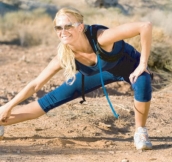 | Stretching has often been seen as a means to increase flexibility, improve muscle strength and tone as well as improve breathing and reduce stress. However, some of the latest research suggests that having greater flexibility may also increase arterial flexibility which may put you at lower risk for a heart attack and/or a stroke. The study suggests that those with poorer flexibility may have more rigid arterial walls which make the heart work harder to pump blood. |
However, the study also points out that stiff arteries don’t necessarily indicate or inevitably lead to arterial disease. That being said, this just might be reason enough to check out that yoga class at the gym in the mornings before/after work, pick up a yoga DVD for home or start an office stretching regime at your desk.
| |
Monday, 16 July 2012
How to Get to Your Healthy Weight
Our daughter Lindsay, sent the following link as a suggested post for our blog. Lindsay is a Registered Dietitian and is our "go-to" person when we are looking to get reliable and up-to-date information about food, eating, metabolism .....just about everything related to nutrition. Lindsay is also a fitness instructor and is often asked these types of questions by her clients. Rather than dissect anything from this article, you're getting the whole thing. It addresses the following:
Here's the link:
http://www.hsph.harvard.edu/nutritionsource/healthy-weight/healthy-weight-full-story/
- Obesity and Health Risks
- What's a Healthy Weight? Body Mass Index (BMI) Defined
- Waist Size Matters Too: Abdominal Fat and Health Risks
- Keeping Things Level
- What Causes Weight Gain?
- What Leads to Weight Loss?
- Lessons From Losers
- General Strategies for Achieving or Maintaining a Health Weight
- The Bottom Line: Recommendations for Health Weight
- References
Here's the link:
http://www.hsph.harvard.edu/nutritionsource/healthy-weight/healthy-weight-full-story/
Wednesday, 27 June 2012
Standing Ab Exercises
It can
be a defining moment in an adult's life, that moment when they realize they
don't have to do a zillion crunches in their workout. In fact, it is
entirely possible to work the Abs and back without a single crunch...without
even getting on the floor.
We also know that working the body as a whole is a lot more effective than trying to isolate different muscle groups (like crunches do). What that means for your Abs is that, while crunches and other floor exercises still have a place in our training routines, standing Ab work can add a new depth and dimension to your workouts, giving you more than just strong Abs, but a strong core.
What do you think? Are you over crunches and looking for something new? How do you work your Abs and do you focus on both floor and standing exercises?
Here’s what I think are the 10 most effective Ab exercises:


While side bends won't necessarily whittle your waist (that comes from losing body fat), this overhead side bend is a great way to strengthen the muscles of the waist (the obliques) while also targeting the Abs and lower back.

The windmill is an excellent exercise for the entire body with a strong focus on the obliques and the lower back. With this move, formis everything. You can add intensity by holding weights in both hands.


Not only is it possible but, in some respects, it's preferable.
Floor exercises have their place, of course, but working the Abs from a
standing position, either with exercises that are integrated into your workout,
or with targeted core exercises, focuses on the Abs the way they function in
real life - as a support for all the movements you do each day ….walking,
bending over to pick something up, lifting something overhead or twisting
around to grab something behind you.
The study behind these exercises suggest these moves are the
best for recruiting all those muscle fibers in your Abs but, with the shift
towards functional training, we now understand that we need strong Abs, not
just while lying on the floor, but for all the movements we perform each day.
We also know that working the body as a whole is a lot more effective than trying to isolate different muscle groups (like crunches do). What that means for your Abs is that, while crunches and other floor exercises still have a place in our training routines, standing Ab work can add a new depth and dimension to your workouts, giving you more than just strong Abs, but a strong core.
What do you think? Are you over crunches and looking for something new? How do you work your Abs and do you focus on both floor and standing exercises?
Here’s what I think are the 10 most effective Ab exercises:
Reverse wood chops are great for the Abs because they involve rotating the body and bringing the arms from the hips and across the body to the opposite shoulder. This dynamic exercise requires the Abs and back to stabilize the body throughout the movement.
Like the reverse wood shops shown above, horizontal wood chops take your body through a rotation, moving the arms from one side to the other and targeting every muscle in the Abs and back with some core stabilization thrown in.
The overhead squat is an advanced Ab exercise that looks easier than it is. Your Abs and back work hard to keep the body in position as you squat and rotate to bring the arm overhead, making this a dynamic, whole body exercise. Start with no weight.
Medicine ball circles are one of my favourite exercises for warming up the entire body, especially the Abs and back. The idea is to circle the weight, making the biggest circle you can while using your whole body in the process.
The static lunge with a med ball rotation is another great exercise for working the Abs and back while building endurance in the lower body. The idea is to engage the stabilizer muscles in your legs and hips to hold a lunger while rotating the medicine ball slowly to one side and then the other. As a modification, keep the medicine ball close to the body as you rotate, focusing on keeping the entire movement centered on the torso.
Figure 8 lunges are a total body exercise emphasizing core strength and stability along with lower body endurance and overall balance and coordination.
The key to making this move effective is to start by performing each move separately. Step forward into a lunge with the right leg and hold that position, getting your balance. Then, take the ball to the opposite hip, rotating through the torse, and sweep the ball down and up in the first half of your figure 8. Then step the right foot back to start before taking the same leg back into a reverse lunge. Hold that position as you complete your figure 8 motion to the other side. Do all reps on one side before switching legs.
The standing side crunch is all about the obliques, with an added challenge to your balance and stability. To really engage the obliques, go through a full range of motion and keep the movement slow and controlled. As you bring the knee toward the elbow, keep the chest open rather than rounding forward - imagine that your back is against a wall and you're sliding along the wall as you do this exercise.
The standing crossover crunch looks a lot like the bicycle move done on the floor, with an emphasis on the obliques. To really get the most out of this exercise, go slow and focus on bringing the shoulder towards the hip, rather than the elbow to the knee. This will put the focus through the torso and engaging the core rather than swinging the arm towards the knee.
Subscribe to:
Comments (Atom)